- The Growth Playbook
- Posts
- LinkedIn lead magnets that actually convert
LinkedIn lead magnets that actually convert
Most founders treat LinkedIn like a brand awareness channel. They post, get likes and comments, feel good about the engagement, and then... nothing happens.
Most founders treat LinkedIn like a brand awareness channel. They post, get likes and comments, feel good about the engagement, and then... nothing happens.
Your impressions go up. Your follower count ticks higher. But your calendar stays empty.
I've spent the last two years obsessing over one question: how do you turn LinkedIn attention into actual pipeline? The answer is simple. Give people an obvious, valuable next step. That's where lead magnets come in.
But here's the thing. Most lead magnets suck. They're fluffy PDFs that overpromise in the post and underdeliver when you download them. People feel tricked, and you lose trust.
This guide shows you how to build lead magnets that people actually want, how to promote them on LinkedIn, and how to turn those opt-ins into sales conversations. Let's get into it.
The lead magnet quality filter
Before you build anything, run it through these two questions:
Would your ICP pay $50 for this if it were a product?
Would they share it with their boss in Slack?
If the answer to either is no, it's not good enough. You need to over-deliver to break through the skepticism most people have around lead magnets.
What makes lead magnets convert on LinkedIn
Good lead magnets have three things in common. They're narrow in scope (one problem, one outcome). They use templates, workflows, and examples instead of theory. And they include specific, concrete numbers in the promise.
When I say specific numbers, I mean things like "sequences that booked 100+ meetings" or "playbook that added $200K in pipeline." Vague promises like "grow your business" or "improve your outreach" don't work anymore.
You also need a strong visual. Think of it like a YouTube thumbnail. Show a graph, a funnel diagram, or a quick GIF preview that scrolls through the asset too fast to read. You want to show just enough to build curiosity, not enough to satisfy it.
The 6 lead magnet formats that work
Templates and frameworks
This is where you should start. Fill-in-the-blank docs, scripts, sequences, copy frameworks, slide decks. People can plug them into their workflow immediately, which means the friction is basically zero.
Examples that work:
"The outbound sequence we used to go from 20 to 80 meetings/month"
"3 email frameworks that consistently get >30% reply rates from CFOs"
"The exact discovery call deck we use to close $50K deals"
Use power words like Template, Framework, Workflow, Swipe File, Kit, Pack in your hooks.
Databases and collections
Curated libraries of examples, messages, or resources. People love inspiration they can revisit and mine for ideas.
This works best when you have high quantity and clear selection criteria. Don't just dump 100 random examples. Show that you filtered for quality.
Examples:
"Library of 150+ outbound messages that got >20% reply rates"
"Database of 50 under-the-radar LinkedIn accounts every founder should follow"
The key is making people feel like you did the research work for them.
Proprietary data and research
Insights pulled from your product data or original research your team runs. This feels like insider info competitors don't have. It's highly shareable internally.
The copy pattern here is simple: "We analyzed [X] across [Y time period] and here's what we found."
Examples:
"What we learned after analyzing 500+ outbound campaigns that booked meetings"
"2026 compensation benchmarks for early-stage GTM teams"
When you have real data, use it. It builds authority faster than anything else.
Blueprints and playbooks
Step-by-step workflows to achieve one specific, desirable outcome. People would rather copy a working system than build their own.
Examples:
"The LinkedIn playbook that took us from 0 to 50 qualified demos in 90 days"
"Our full system for turning cold DMs into booked calls"
Power words: Blueprint, Playbook, System, Operating System, Guide.
This is what we built for our LinkedIn pipeline playbook. It walks through the entire system, start to finish.
Third-party breakdowns
Reverse-engineering the funnel or strategy of a well-known operator or company. The big name stops the scroll. Your analysis delivers the value.
This is "credibility jacking" done right.
Examples:
"I reverse-engineered how [known founder] turns LinkedIn followers into 200+ product signups/month"
"Inside [well-known company]'s outbound engine and how to copy it"
Just make sure you actually do the analysis. Don't half-ass this one.
Repurposed long-form content
Take your existing newsletters, webinars, or videos and reframe them as one of the formats above. You don't need net-new assets. Better packaging and distribution gives you more leverage.
Turn a newsletter into "The [topic] Playbook." Turn a webinar into "Comment 'playbook' to get the full breakdown."
This is the fastest way to get started if you already have content.
How often to run lead magnets
Here's the cadence I recommend:
Weekly: One "comment for X" or "DM me 'X' for Y" style lead magnet post.
2-3x per week: Regular posts with a soft P.S. CTA to a relevant lead magnet.
Always-on: Set a flagship lead magnet as a Featured link on your LinkedIn profile. Alternate between newsletter signup and lead-magnet-specific opt-ins depending on your current goals.
Don't overthink it. Just start with one strong lead magnet and promote it consistently for a month. See what happens.
Turning opt-ins into pipeline
This is where most people drop the ball. They collect emails and then... nothing. Or they send one generic "thanks for downloading" email and wonder why nobody books a call.
Treat lead magnet opt-ins as high-intent leads. Build the system before you start promoting.
CTA inside the asset
The last page or slide of your lead magnet should clearly offer the next step. "Ready for us to implement this with you? Book a call." Link to your calendar, a booking page, or a short application.
Don't be shy about this. People who download your stuff want to know how to work with you.
Email nurture sequence
Set up a 15-30 day sequence that moves people from "curious" to "confident enough to talk to sales."
Alternate between:
Pain and problem clarity (remind them why this matters)
Case studies and social proof (show them it works for others)
Deep educational content that builds trust and authority
This is the same approach we use for outbound that actually books meetings. Consistent follow-up with value, not pushy sales pitches.
SDR or founder follow-up
When someone opts in and they match your ICP, that's a buying signal. Have your SDR or do it yourself: send a short, personalized LinkedIn DM or email referencing the asset.
Ask a simple, forward-moving question. "Are you actively working on [problem] right now?" or "What made you download this?"
No spammy cadences. One or two thoughtful touchpoints.
Your execution checklist
Here's how to actually ship this:
1. Commit to a cadence
Ship one new lead magnet every other week. Only go weekly if you can keep quality at 9-10/10.
2. Pick your starting format
Start with templates or frameworks. Lowest friction, most predictable results.
3. Craft a measurable hook
Include specific, believable numbers tied to outcomes that matter to your ICP. "Booked 100 meetings" beats "improved outreach" every time.
4. Design a strong visual
Graphs, diagrams, or GIF previews that tease the value. This makes or breaks your scroll-stopping power.
5. Build your infrastructure first
Set up your opt-in form, email nurture sequence, and SDR follow-up process before you post. Don't wing it.
6. Double-dip your content
First publish as gated (comment/DM for access). Then 2-3 weeks later, share a high-level ungated version on the feed for extra reach.
Making this real
At Catalyst, this is exactly the kind of system we help founders build. Turning founder-led content into a predictable pipeline engine. Not just followers and impressions, but demos and revenue.
The gap between LinkedIn attention and actual pipeline is fixable. You just need to give people a clear, low-friction next step that over-delivers on value.
Start with one strong lead magnet this week. Pick a format, build the asset, set up the follow-up system, and ship it. See what happens.
Want to build the content engine that feeds these lead magnets?
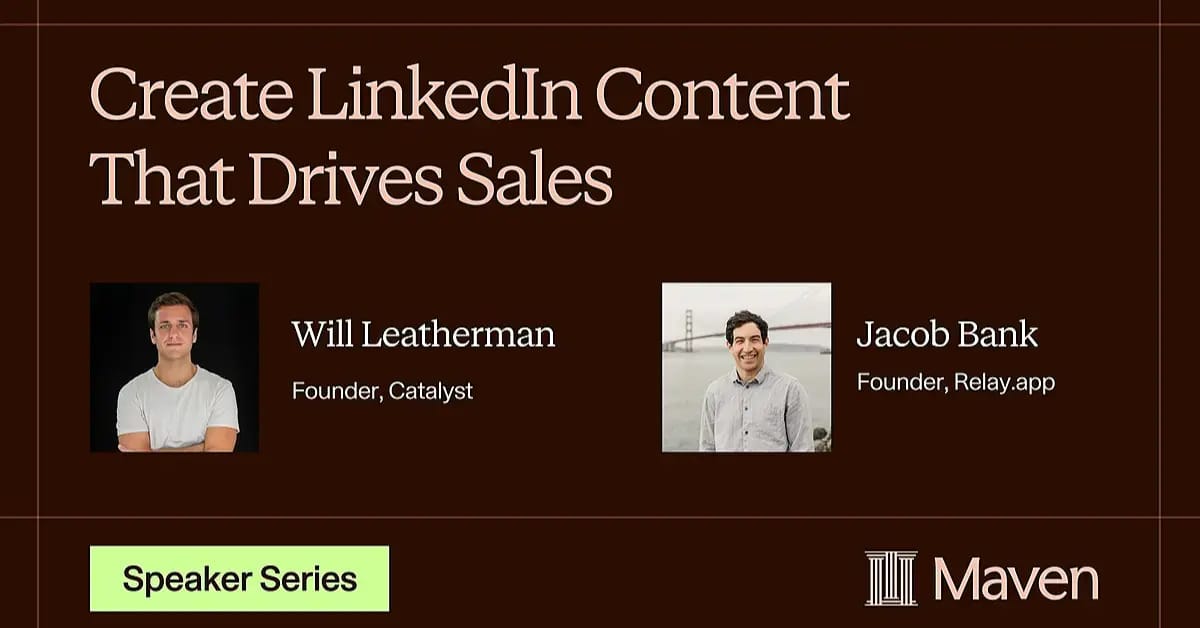
Lead magnets only work when you have consistent content driving attention to them. This Wednesday (Jan 21, 3:30 PM ET), I'm hosting a free workshop with Jacob Bank from Relay on how to create LinkedIn content that actually drives sales.
We'll show you:
The 6-lever hook formula that stops scrollers
How to turn 30-minute conversations into 5-10 posts (no writing from scratch)
AI workflows that maintain your voice while scaling output
A sustainable posting cadence that fits your calendar
This is the system that feeds everything we just covered. 45 minutes, completely free.
—Will